
In honor of the forever unforgotten souls who suffered through the Vietnam War — and to my daughter, Trần Thy Patricia.
May this story, drawn from my life, illuminate the blessings around us and inspire gratitude.
April 2025 — Fifty years after the fall of Saigon
-Trần Trung Tín
The Unfinished Art
In the 1960s, a Vietnamese student was sent by his family to France to study architecture. After a year of dedicated study, he realized that his true passion lay not in architecture — but in painting.
He knew all too well that if he wanted to pursue a subject his father disapproved of, he would have to do it on his own. His best option was to apply to an art school that offered full scholarships.
To be admitted, he needed to submit an application and pass the entrance exam.
That year, the exam was a nude drawing, with a young model posed artfully in the flower garden behind the school.
When the time came, candidates found a suitable corner, set up their easels and began their work. Attentive. Focused. Passionate. Drawing.
Time passed slowly. Eventually, it was over.
When he submitted his drawing, the Vietnamese candidate had only completed something that still seemed unfinished.
Not a single line in it suggested nudity.
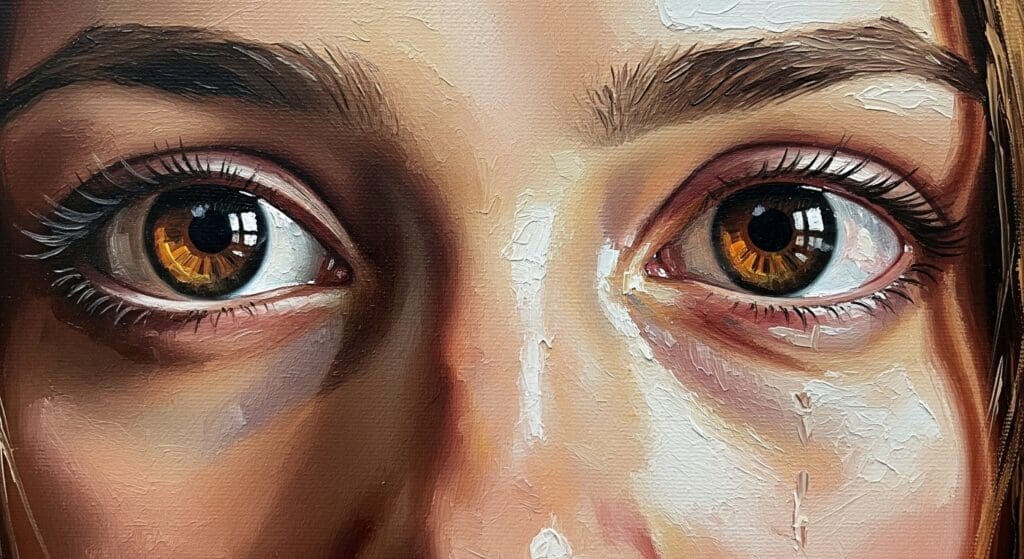
But dominating the entire canvas were the model’s eyes — her gaze captured in strokes that words could hardly describe.
Back at the dormitory, when a friend asked how the exam had gone, the student answered curtly, as if his soul had been hypnotized by the very eyes he had just drawn.
Despite submitting a painting completely off-topic, when the results came out, his name was on the list of those admitted to the school.
Years later, after a life of wandering the streets of Paris, he became one of the painters whose works were cherished by the city’s art lovers.
The Struggle
In the early 1970s, when I first heard the story about this art student, I was still in high school in Vietnam. I couldn’t help but scoff:
“That’s bull! Big mouth. You wanna talk big? Fine! Just don’t blow it out of proportion!”
And so, life at school just drifted by…
After graduating in 1974, I enlisted in the South Vietnamese armed forces.
Then came April 30, 1975 — the day Saigon fell to the North Vietnamese communists. It was also the day that marked the beginning of a long, dark descent for those of us who had once worn the uniform of South Vietnam: persecuted under repression, living in fear, and enduring the quiet agony of survival under a regime that saw us not merely as enemies — but worse, as traitors.
A couple of years later, I was imprisoned after a failed attempt to flee Vietnam on foot — shattering all hopes of reaching Thailand. After my release — secured through a bribery payoff — I had to live for years in hiding as a fugitive, right in the very place where I had been born and raised. During that time, I lived like a hunted man. Just a stroke of bad luck could have landed me back in a ‘re-education’ camp at any moment. The constant, haunting feeling of despair in total entrapment made me want to end my life more than once.
Then came a life-changing moment. In November 1981, I managed to escape by boat. After four nightmarish days adrift in the unforgiving open sea aboard a tiny 11-meter (approximately 36-foot) wooden fishing boat, we — 75 so-called “boat people,” including women, the elderly and young children — were rescued by an oil tanker. The crew later transferred us to a refugee camp in Indonesia under UNHCR’s care.
Eventually, in November 1982, my journey as a refugee brought me to America — a new beginning, after so many endings.
Looking back, I realize that at certain life-threatening moments — especially when I was running for my life — I became numb, unable to feel, let alone explain, what was happening around me. At those junctures, my most trusted companion — my memory — quietly gathered and sealed away the images that suffocated me.
Much later, when memories returned and brought me back to those chaotic days, I thought again of the art student in France. And I realize how recklessly I had spoken back then:
“That’s bull! Big mouth. You wanna talk big? Fine! Just don’t blow it out of proportion!”
The Peace amid Death
Let me take you back again — to April 1975. My unit was retreating from the Central Highlands to the South. As our convoy rushed past Phan Rang, I suddenly caught a glimpse of a weary, ragged man sitting motionless beside a cow, in front of a rickety thatched house along the road.
In the blink of an eye, the house was behind us, but in that same instant, I caught a pair of eyes — two beings, yet strangely the same. The man. The cow.
My God — how could their gazes look so much alike?
The cow… lying beside the man. Slowly chewing its cud. Sluggishly watching the world. Motionless. Indifferent.
That gaze seemed completely immune to tragedy — to death unfolding all around.
The explosions, no matter how close, could no longer shake the man. The stench of burning homes couldn’t pierce him anymore. In that split second, he looked like a man removed from the world — a soul suspended in stillness.
Could it be that fear — excessive, paralyzing fear — had transcended the man? Had it lifted him to the point of enlightenment, rising above the inevitability of life and death, above the suffering of life itself?
Or had it dragged him downward — into a pit of inferiority so deep that he became equal to an animal, like the cow? Able only to see life through a blind, primal lens of instinct, no longer able to tell life from death.
In that suspended instant, I felt as though I were no longer just a soldier passing by but a painter, compelled to seize the scene before it vanished. What struck me was not the man nor the cow in themselves, but their gazes — vacant, indifferent, mirroring one another — as though drawn into the same pair of eyes. A pair of eyes that seemed to belong to neither man nor beast alone, but to some shared realm beyond fear, beyond hope.
Isn’t it true that the painter’s calling is to look without turning away, and to preserve what cannot be spoken — even the silence hidden inside a pair of eyes? A silence at once precious and terrifying, at peace… amid death.
The Full Cycle
Much later in life, when the old story started to crawl back, I saw it differently. I felt I was finally beginning to understand why that student passed the entrance exam — despite being off-topic.
The requirement was a nude painting. But when the jury looked at his canvas, all they saw were the model’s eyes. And still — they accepted him.
Perhaps, just perhaps, he had captured something far more powerful than the aesthetic of the model’s body. Maybe, in that unfinished gaze, the jury saw a reflection of something deeper: a mind torn in polarized conflict — between burning temptation and pure devotion to art. A stare filled with pensive tension — between liberation and suppression, conviction and contradiction, vulnerability and strength.
It reminded me of the man by the roadside — with his eyes buried in both awakening and madness. The same gaze, stripped of expression, as the world collapsed around him. Beside him, the cow still lay quietly. Slowly chewing its cud. Indifferent. Watching life completely fall apart.
*Trần Trung Tín is a Vietnamese American. He was a member of the South Vietnamese Armed Forces. He fled Vietnam in 1981 as part of the “boat people” exodus and arrived in the U.S. in 1982. His writing reflects the memory of war, loss, and resilience.
Editor’s notes: Captivating story! “The eyes are the windows to the soul.” No doubt, the author gave a faithful rendering of the student’s acceptance into the art school. Yet, could there be other explanations that led to the jury’s selection of that Vietnamese student i.e. his audacity to think out of the box, his originality as an artist, his use of freedom of self-expression, the beauty of his painting…We would like to hear from our readers!